Do Phone Plans Affect Your Credit Score?

two people wondering Do phone plans affect your credit score

If you’re in the market for a phone plan, there’s something you should be aware of. A phone plan is a type of credit. Therefore, the answer to the question “do phone plans affect your credit score?” is yes. Tippla has outlined how and why your phone plan influences your credit rating below.

What is a phone plan?

A phone plan (also referred to as a post-paid plan) is a contract where you get a phone, as well as voice, SMS and data inclusions for a single price. With a plan, you don’t have to pay for the phone outright, instead, you pay a monthly fee at the end of the month which includes the cost of the phone as well as your usage. If you take on a phone plan, you don’t own the phone until you’ve paid it off. 

Postpaid vs prepaid: what’s the difference?

Postpaid and prepaid are the two main types of phone plans you can have in Australia. The main difference between postpaid and prepaid is when you pay for the service. As we mentioned above, with a postpaid phone plan, you pay at the end of the month and pay based on your usage.

With a prepaid plan, however, you pay at the beginning of each month. Typically with a prepaid plan, you pay a fixed monthly amount for pre-determined parameters, such as your monthly data, text and phone calls. 

In addition, with a prepaid plan, you generally need to already own the phone you use. Whereas with a postpaid plan, the phone often comes with the plan and can be used as a way of buying the phone you want without having to pay the full amount upfront.

Why would you get a postpaid phone plan?

There are a number of reasons why you might want to get a postpaid phone plan. The main reason would be if you want to buy a new phone, but you don’t want to pay for it outright. Taking on a phone plan can allow you to purchase a new phone and pay it off in instalments, as well as cover your phone and data usage.

With a prepaid plan, you pay a fixed amount each month and as a result, you get a set amount of inclusions: data, texts and calls. If you exceed your set inclusions, then you will need to recharge your phone again.

With a postpaid plan, however, because you’re not paying your bill until the end of the month, you can exceed your plan’s limitations. Whilst you will have to pay for the extra usage, you don’t have to worry about not being able to use your phone if you do go over.

Another thing to consider is how do phone plans affect your credit score? A postpaid phone plan can impact your credit score, whereas a prepaid plan isn’t likely to influence your score at all. We’ll provide a detailed breakdown into how do phone plans affect your credit score below.

Who offer phone plans in Australia?

In Australia there are three mobile networks – Telstra, Optus and Vodafone, also referred to as telecommunication companies (or telcos). Whilst these three networks do offer wide coverage, the quality of the coverage will depend on where you live and what mobile communications standard your phone can connect to (3G, 4G or 5G). This is especially true for regional and rural areas.

mobile phone market share 2020

In terms of who offers phone plans, there are many telcos in Australia that offer phone plans. Telstra, Optus and Vodafone all offer their own phone plans based on their networks and these guys are the big three telcos in Australia. However, there are many smaller telcos that offer a range of plans, but they’re all based on one of the three networks. 

In fact, in Australia, you can get a phone plan from your supermarket, with Coles, Woolworths and Aldi all offering their own phone plans. But there are a range of other providers such as dodo, iinet, Moose, TeleChoice – the list goes on and on.

That’s why it’s a good idea to know what network will offer you the best coverage based on your location and needs. Once you’ve determined this, you can shop around for a phone plan that meets your usage needs, such as the amount of data you want, texts and phone call limits.

There are a number of comparison sites that have compiled many of the phone plans on offer. However, they don’t necessarily show all of the options out there. That’s why it’s good to shop around online.

How do phone plans affect your credit score?

Now let’s tackle the next question – how do phone plans affect your credit score? Just like a loan or credit card, a postpaid phone plan is considered to be a line of credit. A prepaid phone plan is not a line of credit as you’re paying for the service upfront.

1. Telcos will typically check your credit score

What does this mean? When you apply for a postpaid phone plan, the telco company you apply with will typically check your credit score, to see how reliable of a borrower you are. This check is known as a hard enquiry, and it will harm your credit score initially.

Regardless of whether you are approved for the phone plan, the hard enquiry will remain on your credit report for five years, as a credit enquiry (credit application). This means, for the next five years, any time you apply for a loan or some kind of credit, the companies you apply with will be able to see this credit enquiry on your report.

2. If you miss your repayments, it could harm your credit score

Going forward, if your application for the phone plan is accepted, then this will be listed as an active credit account on your report. If you default on your phone plan repayments, then this will also appear on your credit report. Initially, this will also harm your credit score. Furthermore, the default will remain on your credit report for up to five years, and any time you apply for credit, the company you’re applying with will see the default.

3. It can help you build a good credit history

On the reverse, a phone plan can help you build a good credit history and boost your credit score. If you can make all of your repayments on time, then this can go a long way to show that you are responsible with your finances.

The trick here is to remain on top of your repayments. Therefore, it’s a good idea to make sure you can comfortably afford your phone plan repayments before you apply.

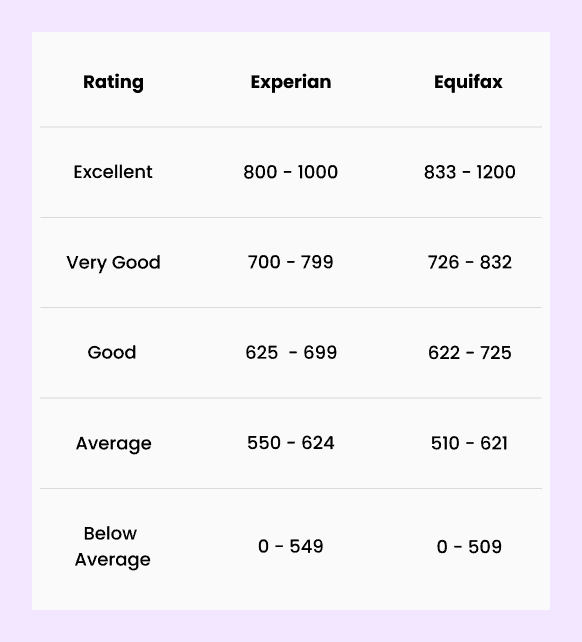
Not sure what’s a good credit score? Here’s how Equifax and Experian categorise your credit scores:
what is a good credit score, good credit score

Source: Experian and Equifax

Can you prevent your phone plan from impacting your credit score?

The short answer to this is yes, there are a number of things you can do to stop a phone plan from impacting your credit score.

1. Opt for a prepaid phone plan

Instead of getting a postpaid phone plan, you can instead get a prepaid plan. Nowadays, prepaid plans can offer really good deals, such as unlimited text and calls and large data limits. 

If you take a prepaid phone plan, the company you buy it from won’t perform a credit check and because you pay for the service in advance, if you miss a payment, it won’t harm your credit score.

However, if you take out a prepaid phone plan, then you will need to pay for your phone outright or use the existing phone you’ve already paid for. So whilst a prepaid phone plan won’t impact your credit score, it isn’t always a suitable option.

2. Always make your repayments on time

As we highlighted above, if you take on a postpaid phone plan, if you default on a monthly repayment, then this will appear on your credit report. Not only will it harm your credit score, but it will also serve as a black mark on your report for up to five years.

In order to avoid this, it’s important to make your repayments on time. If you consistently make your repayments, then this can actually be good for your credit score and show that you are a reliable borrower.

3. Try not to exceed your plan limitations

In line with making your repayments on time, one way you can help yourself out with this is by making sure you don’t exceed the plan’s limitations. If you go over your data usage then your provider might give you extra data as a top-up automatically and charge you for the extra data – even if you don’t use it all. This is sometimes called an add on.

When you get close to having used all of your data, you will likely receive a text or an email from your provider, however, these can be easy to miss. Whilst one top-up might not cost much, if you end up needing several top-ups, it can get costly.

That’s why it’s a good idea to keep an eye on your usage as you go through the month and try not to exceed your limitations. You can also speak with your provider on whether you can disable automatic top-ups.


Budgeting for Car Ownership: A Full Cost Breakdown

Owning a car is a dream for many Aussies. It’s about having your own freedom, flexibility, and hitting the open road whenever you please, or just going down to the corner shop whenever you’re craving a sweet treat. 

However, before you picture yourself winding along the coast or zipping to work in the comfort of your own car, it’s smart to crunch the numbers and think about your finances. Car ownership comes with a mix of costs, some obvious, some hidden, and if you want to steer clear of any expensive surprises, it pays to know exactly what you’re signing up for.

The true cost of owning a car in Australia will be revealed here, along with a deep dive into how you can keep your budget on track, without cutting corners on safety or comfort.

The Upfront Expenses of a Car

When purchasing a car, the largest expense will be at the start when you purchase the car itself. 

It’s a prime opportunity to consider whether you are after a new car or a used car. If you’re after the former, it’ll be more expensive upfront, but it will come with warranties and the latest features, just keep in mind it will depreciate quickly. If you’re looking for the latter, a used car is usually more affordable, but may need more repairs or maintenance sooner. It is important to note that if buying from a dealership, you will incur a dealer delivery fee.

Once you’ve acquired your new set of wheels, you’ll have to pay for stamp duty and registration (or “rego”), to ensure your car can be driven legally. Registration is renewed yearly, and prices will vary by state and by the type of vehicle. Along with your registration, you will need to get plates for your car, which are customisable at an added cost.

If you’re thinking of buying a used car for $1500 in NSW, you can expect:

  • Stamp duty: ~$450
  • Registration: ~ $300 to $700
  • Dealer fee (if applicable): $300+
  • Number Plates: ~$50

Running Maintenance Costs To Keep Your Car On The Road

While the largest initial cost will be purchasing the car itself, the real costs begin when you start paying for ongoing expenses and maintenance that can sneak up if you’re not prepared.

1. Fuel

Whether you’ve opted for a petrol or diesel engine, you will have fuel economy that is dependent on your driving habits, the make of car you’ve chosen and current fuel prices. Driving a petrol sedan in the city will be very different to driving a diesel 4×4 off-road. 

The average yearly fuel cost for a small car in Australia is around $1,500, but it can rise with more kilometres or less efficient models. Consider how you will be using your car and where you will be driving it to estimate the cost of fuel.

2. Insurance

Car insurance is non-negotiable for the safety of your car and finances. Find what options will suit your budget and compare providers to find the best cover for your unique situation.

At the very least, consider Compulsory Third Party (CTP) insurance as you must have this to legally drive anywhere in Australia. If you have finances available to purchase more cover, you could opt for additional protection like comprehensive insurance for fire and accidents and third-party property cover for damages to other cars or property, but not your own.

Before you decide on what’s best for your budget, it’s a great idea to get a quote for car insurance with NRMA Insurance to see what cover fits your lifestyle and budget. While going for the cheapest premium might seem like an attractive option, compare what’s included before you make a decision so you’re not left stranded on a road without a spare tire or a way to ask for help.

3. Maintenance and Regular Repairs

Having your car serviced regularly will ensure that it’s safe and roadworthy while also preventing problems before they empty your wallet. An average annual maintenance is around $800 to $1200 for a typical small to medium car and should be done every 10,000 to 15,000 kilometres or annually.

By servicing and maintaining your vehicle on a regular basis, you reduce the chance of having to fork out money for unexpected repairs, keep your car safe and can improve the car’s resale value.

Other expenses will include replacement brake pads, tyres, windscreen wipers, air filters, oil filters and fuel filters.

4. Tolls and Parking

If you’re using a car to travel for your daily commute, you’ll need to take into account the tolls, where regular commuters can spend over $1,000 yearly, and even parking, where city parking is often $3–$10/hour, or a monthly pass for $300+.

Long-Term Ownership Costs

Long‑term car ownership costs come from three main areas: depreciation of value, loan interest and accessories like car seats, roof racks, dash cams, new tyres, or snazzy floor mats. These costs, especially the accessories, can add up fast but may be ‘must haves’ for your family, safety, or hobbies.

Realist Look At Car Ownership Budgets

On average, a small car in Australia might cost you around $5,620 per year or about $108 per week based on what we have discussed. While this may be the average, this cost could certainly fluctuate depending on the type of car you are running and your driving habits.

Car ownership is a big responsibility, but it’s also incredibly rewarding. With a little planning (and some savvy cost breakdowns), you can cruise ahead without putting your wallet at risk.

6 Ways To Enhance Your Property’s Valuation

Every property owner should strive to improve their commercial lot’s aesthetics and functionality. This not only helps in keeping the building look elegant and attractive, but it also helps keep your lot from getting overlooked in the ever-growing real estate market. 

Furthermore, making these enhancements also helps increase the market value of the property—which can increase its inherent saleability and marketability in both the short-term and long-term.

From facade renovations to room expansions, there are many ways you can increase your commercial property’s valuation and turn it into a money-making machine.

If you’re creatively stifled and unable to figure out the best ways to get your commercial property to stand out against the competition, we got you. This article will lay out six ways property owners can improve their property and increase its valuation with relative ease.

Let’s take a look at these enhancements in more detail.

1. Improve Curb Appeal 

A lot of people would say that first impressions make a big difference in how someone perceives a place—and this can’t be any more true with commercial property. 

Upon entering your property, one of the first things that enter a visitor’s periphery is your curbside. If you want to make an impact, then you have to make it look absolutely striking.

One easy way to give your curb a facelift is by touching it up with some shade structures. These structures, in essence, serve as a protective covering that shields people and objects from direct exposure to the sun and rain when outdoors. 

Besides its inherent protective function, various commercial shade structures, such as the  commercial shade structures with Greenline, can also be designed in a multitude of different colourways and materials. This creative flexibility allows property owners to bring their imagined architectural designs to life quickly.

Besides these architectural pieces, you should also consider landscaping your front lawn. Adding some potted plants, pruning overgrown shrubs, illuminating dark walkways, and cleaning your lawn can all contribute to a lush, green, and inviting space. 

These improvements can convey professionalism and care, thereby helping your property stand out in the competitive real estate market.

2. Increase Rental Price

Don’t get us wrong: you wouldn’t want to unjustifiably and suddenly raise rent prices to your tenants. This can cause a bit more than a scuffle. 

However, if you have slowly worked on improving your amenities and introducing new features to your property, and if local rent prices have also reached new levels due to inflation or other economic conditions, then you can justify increasing your monthly rental price.

An increase in rental price directly correlates with a higher property value in that it increases the building revenue stream. This doesn’t only make it more lucrative for the owner, but it can also be enticing for future investors looking to purchase a commercial lot with a good cash flow.

Furthermore, the increase in cash flow can also help you gain more money to improve your building’s operations. 

Be sure to inform your tenants well in advance so that they’ll have enough time to financially prepare for the change. This shows that you respect your client’s time, which can help reduce vacancy rates.

3. Increase and Expand Rooms

If your layout allows, consider expanding the room sizes of the rooms you currently have in your building. Alternatively, and perhaps even more ideal, consider constructing additional rooms in your commercial space.

Doing these things can help you cater to a wider range of tenants given the increase in room size. It also allows you to take in more tenants in general, thereby increasing your building’s income potential—whether it’s by an increase in income stream or an increase in the rental pay per client.

While you’ll obviously have to pay to upgrade your rooms to make them more spacious, this expansion can attract high-tier tenants who are willing to pay a premium for a fitting room. It also 

Furthermore, this renovation is also a permanent one, which means that your current clients and future ones can enjoy spaciousness for years to come, which adds to your property’s overall appeal.

4. Incorporate Smart Technologies

There are a lot of benefits to having smart technology in your standard commercial property. Smart appliances and fixtures have the power to turn a tech-deficient and unremarkable building into something state-of-the-art, convenient, and visually impressive. 

There are many types of smart technologies a property owner can leverage to upgrade their building. For instance, your building can run automated lighting and cooling systems in offices, allowing these spaces to run smoothly and allowing workers to engage in their tasks with minimal friction and with utmost comfort.

Besides that, the convenience provided by these technologies is also a major perk. For instance, you can install smart parking solutions to optimise traffic flow, payment processes, and space maximisation. You can also use these technologies to gather analytics and insights on your clientele and building management operations.

By making your building tech-forward, you’re helping your building remain competitive now and for years to come. This, coupled with the continued satisfaction of your customers with the help of these technologies, can create more opportunities that you can leverage with your customer base.

5. Keep The Building Facilities Maintained

Your property’s value doesn’t lie in just its structure, its amenities and functionality also matter a lot. Two important factors found in a building system are your plumbing and electrical systems.

Proper plumbing systems ensure that water is properly supplied, drained, and transported with as minimal leaking as possible. If your building often gets complaints of leaks or water shortages, then you should work to improve those conditions to maintain the value of your property.

Even if there doesn’t seem to be a visual problem, it’s best to call in a plumber and have them undergo a thorough inspection. They may spot corrosion or leaks that may lead to bigger and more expensive problems if left unchecked. 

Besides your plumbing system, it’s also essential to keep your place’s electricity in top shape. 

Ensure that your outlets are all working and supplied with electricity, and if not, fix it promptly. Use energy-efficient appliances to save on your utility bill—this will matter a lot over time.

Hire a dedicated electrician who can help your building out in case of sudden electrical emergencies. Alternatively, hire someone who can check on your electricity supply once in a while and correct anything that needs fixing.

If your building’s plumbing and electricity are well-maintained, you’re ensuring safety, efficiency, and comfort within the building. This, in turn, can lead to happy customers and a more attractive building overall.

6. Upgrade Security Features

No one wants to feel unsafe, especially in the workplace. Considering that fact, it’s crucial that you focus on improving your property’s security to ensure that your tenants and their customers are as safe as possible.

Your building, as you’re well aware of, has been fixed the minute you bought it. So if you’re situated in a shady area, then beefing up security is a must to ensure your property remains competitive in the local market.

You can improve security in multiple ways. The first and most reliable one is hiring security officers to rove and secure your property’s parameters. Besides hiring security guards, you should also invest in security equipment like CCTVs, identification turnstiles, and metal detectors to minimise threats.

You should also increase fencing around your area to ensure that your place can’t be easily accessed away from the entry points. In beefing up your security, you signal to investors that you care about the safety of your tenants and customers. This can bring your appraisal value up considerably.

How to Apply for a Credit Card in Australia

People trying to apply for a credit card in Australia

Are you looking for some extra finance for emergencies, for a big purchase, or are you wanting protection from online fraud? Then a credit card might be just what you’re after! But how can you get a credit card? Tippla has put together a quick and easy guide on how to apply for a credit card in Australia.

What is a credit card?

A credit card is a payment card that is provided by banks and similar financial institutions to allow the cardholder to pay a merchant for goods and services using a line of credit. 

So what does this mean? Basically, the money spent on a credit card isn’t the money that you have earned from your job. Instead, it’s a revolving line of credit that you need to repay each month, or at the very least, make the minimum repayments if you want to avoid late fees.

Am I eligible for a credit card?

Who can receive a credit card? This will vary from card to card, and it depends exactly what you’re after. But there are a few general requirements that are applicable for most cards. 

These requirements are:

  • You must be over the age of 18;
  • An Australian citizen or permanent resident and hold a valid visa;
  • Not be going through bankruptcy;
  • Have a decent credit score;
  • Have a stable job and steady income that will allow you to repay the maximum credit card limit.

When it comes to meeting the requirements of a credit card, the main thing the credit provider is concerned with is whether you have the ability to repay your credit card balance every month.

Can you get a credit card with no credit score?

One of the general requirements for a credit card is to have a good credit score. This shows you are responsible with your finances and can make your repayments on time. But what if you don’t have a credit card? Or what if you have a bad credit score? Can you still get a credit card?

The short answer is yes, but your options will be more limited than if you had a good credit score. The main thing banks and other credit card providers are concerned about is whether you can repay your balance. You can do this by showing them you are responsible with your money.

This could mean, highlighting that you have a steady income, a stable job and that you can save consistently. Furthermore, One thing you could do before applying for a credit card is to build your credit history or improve your credit score so that you have a lot more options at your fingertips.

Your options

If that isn’t an option, there are still things you can do. If you’re studying at university, TAFE, VET or working in an apprenticeship, then you may be eligible for a student credit card. You can apply for these types of credit cards without needing a credit score. However, you need to be a student to apply for this kind of credit card, and it might not offer the best terms and conditions compared to other types of credit cards

Alternatively, there are such things as secured credit cards. Similar to a secured personal loan, a secured credit card is where your credit card is “secured” AKA, guaranteed to be paid. This is achieved by having a cash deposit in your bank account that’s the same as your credit limit.

You can also call your current bank and explain your situation. If you have been a customer with them for a while, they might be able to offer you a credit card based on your personal circumstances.

Can you get a credit card on Centrelink?

If you currently receive financial assistance from the government, are you eligible to apply for a credit card? Yes, being on Centrelink doesn’t mean you can’t get a credit card. However, your options might be more limited.

Before applying for a credit card, it’s important to make sure you understand and meet the eligibility requirements. You can compare your options on numerous comparison websites, however, they might not cover the entire market. You can also contact your bank to see if they have any options that meet your needs.

Generally speaking, if you can meet the common requirements – age, Australian citizen or resident, minimum income and good credit history, then there should be a credit card out there for you, regardless of whether you receive help from Centrelink.

Where can you apply for a credit card?

When you’ve determined your eligibility to apply for a credit card, the next question is where can you get a credit card? Nowadays, you can get credit cards from many different companies – and not all of them are financial institutions. It’s no longer just banks that have a monopoly.

Here is an overview of who offer credit cards in Australia:

  • Australian and international banks;
  • Financial institutions, 
  • Airlines, such as Qantas and Virgin;
  • Supermarket chains, such as Woolworths and Coles;
  • eCommerce companies like Kogan;
  • Department stores, including David Jones.

How to apply for a credit card in Australia

Here are the simple steps you can take to apply for a credit card.

1. Do your research

Before you apply for a credit card, one of the best things you can do is research all of your options. Check if you are eligible for a credit card, and discover which credit card is best for you. Could you benefit from a rewards card, or would a card without an annual fee be more worth your while?

Here are some questions you can ask yourself when trying to determine whether a credit card is right for you, and if so, what type of card would best suit your needs:

  • What will I be using the credit card for – day to day spending, to pay for bills, or to make big purchases every so often;
  • Will I be able to pay off my credit card in full each month?
  • Am I, at times, forgetful and not the best at sticking to a budget and therefore, likely to carry over a balance each month?
  • Do I travel a lot?
  • Do I exclusively do my grocery shopping at one brand – like Coles or Woolworths?
  • Do I need a credit card, and can I afford it? Do I already have a lot of debt?
  • Will a credit card help or harm my credit score?

2. Contact the company you want to apply with

Every time you make an application for credit the company that you apply with will check your credit score and report unless you go with a no-credit-check lender. When a lender checks your credit report, it registers as a hard enquiry on your report, and it harms your credit score. 

The hard enquiry will be registered on your credit file regardless of whether you’re approved for the credit or not. Because of this, another thing you can do is when you’ve made a decision on which card you want and where you want to apply, you can contact the company directly.

Why would you do this? Because you can clarify with them whether you meet the eligibility criteria. They probably won’t be able to tell you whether you’ll be approved or rejected without you making the application, but they might be able to give you a better idea.

Therefore, when you make the application, you can be more secure in the fact that you will be approved, and keep the impact on your credit score to a minimum.

3. Submit your application

Once you have done your research, and you’re sure you meet all of the eligibility requirements, you can then submit your application. Most companies will allow you to apply online. These forms generally don’t take very long.

Alternatively, if you’re applying for a credit card with a bank, you can go to your local branch and submit your application in person.

Summing it up

 We’ve thrown a lot of information at you, so let’s sum it up. Here’s how to apply for a credit card in three easy steps:

  1. Do your research – identify why you need a credit card and which type of card would be best for you. Once you have determined this, you can then find which company can offer you the best deal;
  2. Make sure you meet the eligibility criteria – when you’ve found which card you want, take a look at the eligibility criteria to make sure you meet the company’s standards. If you’re not sure, you can contact them to try and get a better idea;
  3. Make your application – the easiest way is to apply online, however, if you’re applying with a bank, then you can go into your local branch if you’d prefer to do it in person.

Bad Credit Loans | What Are They & How To Apply for Them

Bad Credit Loans

If you have a below-average credit score but you still want to take out a personal loan, what are your options? There is such a thing as bad credit loans. Tippla has provided a breakdown of bad credit loans below – what are they, the pros and cons of poor credit loans and how to apply for them.

What are bad credit loans?

As the name suggests, a bad credit loan is a loan you can take out when you have a “bad” credit score, also known as below average. The point of a bad credit personal loan is to allow people who don’t have a stellar credit history the opportunity to still access finance. 

This can be helpful for people who need a loan but don’t have a great credit history and don’t have the time to improve their credit score.

Why does my credit score matter when applying for a loan?

Your credit score is a number ranging from 0 – 1,200 and it acts as an indicator of how reliable of a borrower you are. Your credit score is based on your recent credit history – your credit applications, your repayment history, the number of credit accounts you have, and any negative entries if applicable (defaults, bankruptcies, court judgements, etc).

Because of this, your credit score gives credit providers a helpful overview of how you have managed credit in the past. Lenders and banks use your credit score to judge how much of a risk you pose to them when you apply for some kind of credit, whether it be a loan, credit card, mortgage and more.

The higher your credit score, the more reliable of a borrower you are perceived to be. This can go a long way when it comes to applying for credit. This is because you’re more likely to be approved for a loan if you have a good credit score and positive credit history.

On the reverse side, if you have a bad credit score and a bad credit history, then your loan application might be rejected and credit because lenders will see you as too much of a risk.

What is a bad credit score?

Your credit score will fall somewhere on a five-point scale: excellent, very good, good, average and below average. Below average is also referred to as a “bad” credit score. 

Where your credit score falls will depend on the Credit Reporting Agency (CRA). In Australia, there are three CRAs – Equifax, Experian and illion. Each of these three agencies collects your credit information and generates your credit scores and reports. That means you have not one, but three credit scores and reports.

Equifax measures its credit scores on a scale from 0-1,200, whereas Experian and illion use a scale ranging from 0 – 1,000. Here’s how Equifax and Experian categorise their credit scores.

what is a good credit score, good credit score

Source: Experian and Equifax

The pros and cons of bad credit loans

Are bad credit loans a good or a bad thing? Well, there are arguments for both sides. So let’s take a look at the pros and cons of bad credit loans.

Pros

1. Access to finance

One of the good things about bad credit loans is that it provides people who don’t have the best credit history with access to finance. Generally, the turnaround for these types of loans is quite fast, which can be helpful if you need cash quickly.

2. Can help you rebuild your credit

If you take out a loan, it can be your opportunity to rebuild your credit history. If you can make all of your repayments on time, and you can pay off the loan in full, these actions can both positively contribute to your credit score.

3. Extended repayment period

In Australia, you can get a range of bad credit loans, with varying repayment periods. This means you don’t have to pay back the amount you borrowed straight away, you can space out your repayments into affordable instalments.

Cons

1. High-interest rates

Lenders are taking on more of a risk by lending to people with a bad credit score. Because of this, they offset their losses with high interest rates. Depending on where you go, you could be facing interest rates of up to 30% per annum in the most extreme cases. 

The amount you pay in interest can add up over time, and it can hurt your wallet. You should make sure you can afford the repayments, including any interest and fees and charges, before taking on a loan.

2. Fees

Not only do bad credit loans come with higher interest rates, but they can also come with more fees. Again, this is a way for lenders to offset the risk of lending to someone with a bad credit score. 

Just like interest, the amount you pay in fees can add up quickly if you’re not careful. That’s why it’s important to read the terms and conditions before taking on a loan.

3. Lower borrowing limits

Typically, if you have bad credit, then you might not be able to borrow as much as you’d like. This will differ from lender to lender, and you might find some that are willing to lend higher amounts, but again, you’ll likely be paying for this in interest and fees.

4. Collateral requirements

Some lenders may require you to offer some kind of collateral to take out a loan. If you default on the loan, then you could be at risk of losing your collateral.

Who offers bad credit loans?

Many lenders offer loans for people with bad credit. A simple google search for bad credit loans will produce pages of results of lenders who are willing to provide loans.

Typically speaking, you are more likely to find non-bank lenders who are willing to take on the added risk of lending to someone with bad credit. 

How to apply for bad credit loans

Before applying for a loan, you should make sure you meet the criteria of the loan. In Australia, you will typically need to meet the following criteria:

  1. Be at least 18 years old;
  2. Be an Australian or New Zealand citizen (or Australian permanent resident/have an eligible Visa);
  3. Live in Australia;
  4. Be employed and receive a regular income.

You can apply for bad credit loans similar to how you would apply for any other loan, however, it is a good idea to do your research before applying. You should try and compare the different options out there, and see which lender can offer you the best conditions, such as interest rates and associated fees.

Bad credit loans: the verdict

To sum it all up, there are pros and cons to bad credit loans. If you are unsure if this type of loan is right for you, then you can reach out for free financial advice with a financial counsellor from the National Debt Helpline.

Why Professional Bookkeeping Resources Make a Big Difference Over Time

When you’re running a business, keeping up with day-to-day operations can be overwhelming enough. Add managing finances to the mix, and it’s easy for things to slip through the cracks. Bookkeeping is often one of the first areas to suffer from neglect or inconsistency. Poor bookkeeping doesn’t just lead to financial confusion, it can affect long-term stability and growth. Relying on professional bookkeeping resources isn’t just a convenience; it’s a smart business decision with a lasting impact.

Image Source: https://unsplash.com/photos/a-calculator-sitting-on-top-of-a-pile-of-papers-741iShluYhk

Reducing Costly Errors and Missed Opportunities

Mistakes in your financial records can be more than just frustrating, they can be costly. Misclassifying expenses, overlooking tax deductions, or delaying invoice tracking can all result in penalties, lost revenue, or even audits. Business owners juggling multiple responsibilities are far more likely to make these errors without proper financial training. Professional bookkeeping services can help prevent these issues by introducing structure, oversight, and attention to detail. Trained bookkeepers understand how to reconcile accounts accurately, catch inconsistencies early, and track every dollar with precision. This level of care not only prevents errors but often uncovers opportunities, like underutilized tax credits or spending trends that signal waste.

When your books are in order, decision-making improves. You’re better equipped to identify growth opportunities, manage cash flow efficiently, and prepare for tax season with confidence. Even small corrections and optimizations add up to significant savings.

Saving Time While Increasing Business Focus

One of the most overlooked benefits of professional bookkeeping is the time it frees up. For entrepreneurs and small business owners, every minute counts. Hours spent trying to reconcile accounts or understand financial reports could be spent developing products, building client relationships, or scaling operations.

Delegating bookkeeping tasks to experts allows business leaders to stay focused on their strengths. You don’t have to worry about falling behind on reconciliations or rushing to compile documents before tax deadlines. With organized books and real-time reporting, you can access insights without doing the heavy lifting.

Professional resources tend to integrate seamlessly with modern accounting tools and software, helping automate processes that would otherwise take hours each month. The reduced mental load alone can translate into better productivity and sharper business strategy.

Laying a Foundation for Long-Term Financial Health

Businesses that survive the startup phase and grow steadily often credit their success to strong financial infrastructure. Bookkeeping is a central pillar of that foundation. Accurate records allow you to forecast with clarity, monitor profit margins, and secure funding with reliable documentation.

When it comes time to apply for loans, attract investors, or prepare for a merger or acquisition, your financials will speak volumes. Sloppy or incomplete records can derail these opportunities. Professional bookkeepers ensure your records remain clean, detailed, and audit-ready at all times.

Beyond documentation, consistent financial tracking helps reveal seasonal trends, budget shortfalls, and areas where spending can be optimized. These insights allow for course corrections long before problems snowball, giving your business a much better chance at long-term sustainability.

Image Source: https://www.pexels.com/photo/person-calculating-on-a-notebook-6962993/

Smart businesses understand that financial management isn’t just about tracking numbers, it’s about building resilience. Professional bookkeeping resources deliver more than reports; they offer peace of mind, time savings, and a stronger financial trajectory. This investment pays for itself in better decisions, cleaner operations, and a greater ability to seize new opportunities as they arise.

How to Use Tippla | Check Your Credit Score For Free

How to Use Tippla

Do you want to check your credit score? Do you want to see your Equifax or Experian credit reports? Then look no further, Tippla has you covered. Here’s a helpful guide on how to use Tippla and check your credit score for free.

What is Tippla?

Tippla is a credit score management platform that allows you to view your Equifax and Experian credit scores and credit reports. Don’t know what a credit score is, or why it’s important? Check out our helpful article here for a breakdown.

Not only can you view your credit scores and reports, but you can also get tailored credit offers on Tippla. If you are looking for a personal loan, then you can complete an application on Tippla, and you will be shown a table of lenders who meet your needs and could be willing to offer you a personal loan, based on your credit score.

What does this mean? You’ve already met part of the criteria to be approved for the loan. 

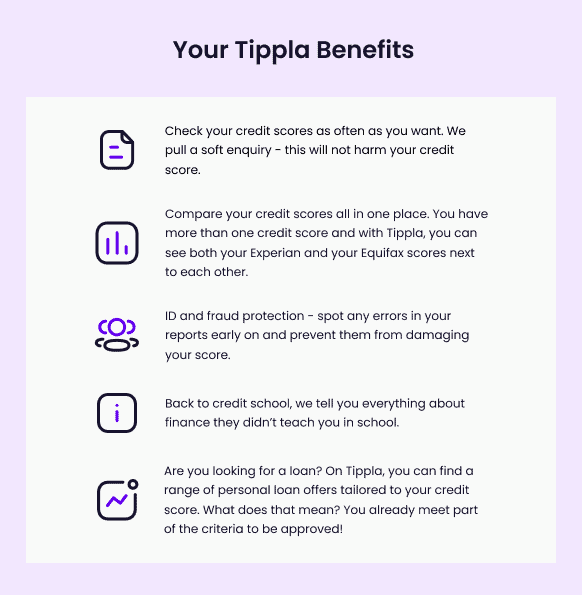
Tippla Benefits

How to use Tippla: Sign-up process

Before you can access all of these great benefits, you need to sign up to Tippla. Because your credit score is sensitive information, we first need to verify your identity. This should only take a few minutes.

You can verify your identity with one of the following ID:

  • Your driver’s licence;
  • Your medicare card;
  • Your passport.

Tip: the ID you use to verify your identity must be active. We can’t accept expired identification as proof of identity.

Once your identity has been verified, you will receive an email with your temporary password. You can use this password to log into your Tippla account, where you will be taken to your Dashboard.

If your ID isn’t automatically verified, you can reach out to our helpful support team to verify your identity manually. Please send them a photo of your ID (if it’s a driver’s licence, please send the front and back of the ID).

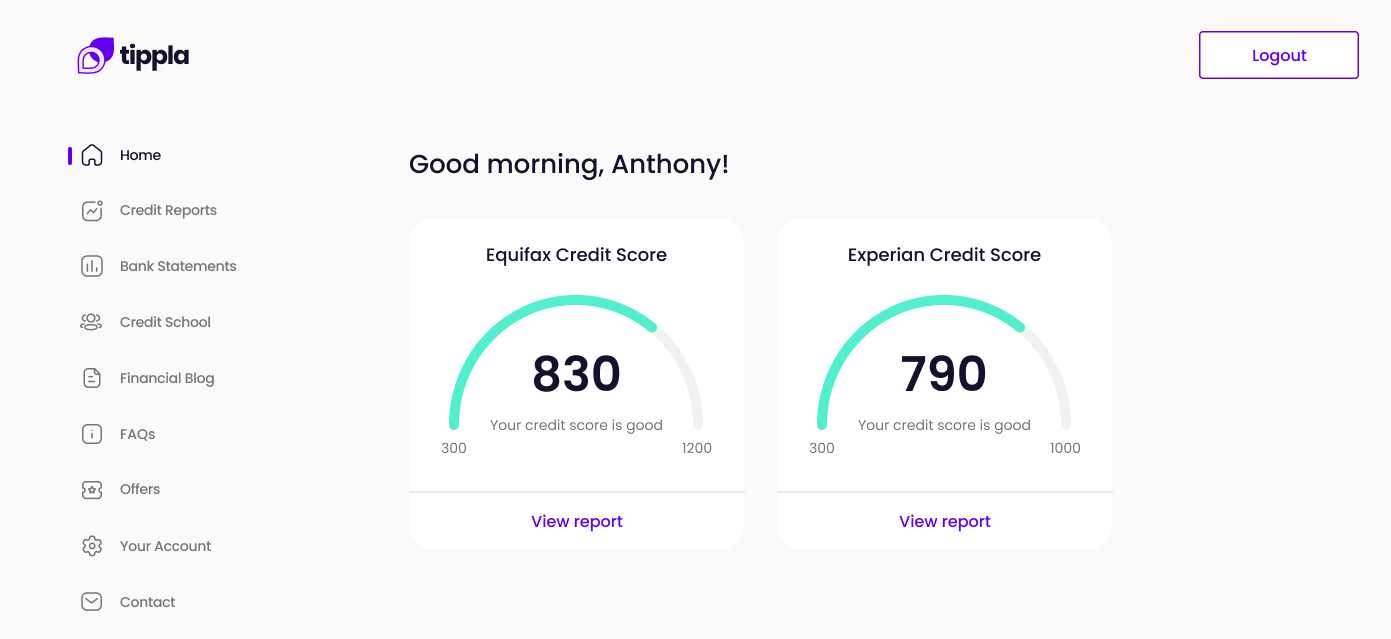
When you have successfully signed up to Tippla you will be taken to your Dashboard where you’ll be able to see your credit scores from Equifax and Experian.

Tippla dashboard

How to check your credit report

For a detailed overview of your credit reports, simply click on the “View Report” underneath your credit scores. When you press this button, you will be shown a more detailed breakdown of your report.

Specifically, you will be able to see the following:

  • Personal information – such as your name, address, date of birth and employment;
  • Credit account information – all of the credit accounts you currently have open or have closed in the past two years, such as any loans, credit cards, utilities, and more;
  • Repayment history – your repayment history for your credit accounts will be listed on your report;
  • Credit applications – every time you apply for some kind of credit, regardless of whether you were approved or rejected, it will appear on your report;
  • Negative entries – this includes bankruptcies, defaults, public records and court judgements. 

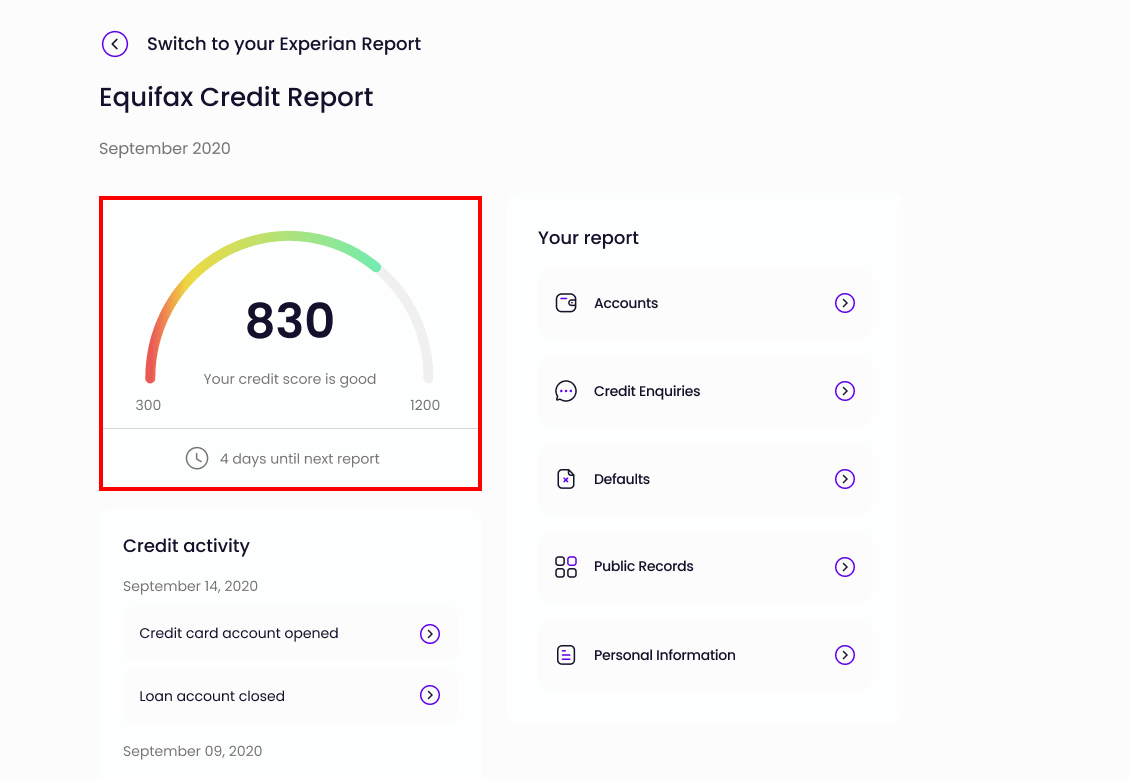
Equifax Credit Report

What can you use Tippla for?

You can use Tippla for many things, and the benefits will only increase as time goes on and we add even more features.

Check your credit score

In Australia, you have three credit scores. On Tippla, you can see two of your credit scores from the largest credit reporting agencies in the world – Equifax and Experian. Viewing your credit score gives you the opportunity to improve your financial independence – knowledge is power.

If you have a below-average rating, you can learn how to improve your credit score with Tippla. Or, if you already have a good credit score, you can learn how to keep it that way!

Check your credit report

Not only can you see your credit scores on Tippla, you can also see your Equifax and Experian credit reports. Not sure what’s the difference between your credit score and report? Your credit score is a number ranging from 0 – 1,200. This number is based on all of the information contained in your credit report.

Not only is it a good idea to check your credit report to see where you stand, it’s also important to make sure all of the information is correct. Did you know, 1 in 5 credit reports has some kind of mistake on them? This mistake could be harming your credit score, and could be hindering your chances of being approved for a loan.

Get access to personalised offers

On Tippla, there are a range of offers just waiting for you. Are you looking for a personal loan? Simply fill out the application form on our Offers section, and you will be shown a range of personal loans from different lenders. 

These loans will be tailored to your credit score. What does this mean? You already have the right credit score required from the lender to be approved for this type of loan. Therefore, you have already met part of the criteria, increasing your chances of being approved for the loan.

Increase your financial literacy

Tippla’s mission is to provide Australians with easy access to their credit scores, as well as improve their understanding of credit scores. As part of this, you can access a wealth of content that can help you increase your financial literacy.

Check out Tippla’s Credit School

When you sign up for Tippla, you can take a short online course with Tippla’s Credit School. This course will provide you with all the information you need to know about your credit score – what is it, why does it matter, and how to improve your credit score.

Not only that, through Tippla’s Credit School, you can learn techniques to help you effectively manage your debt, budgeting tips and other information that can help you improve your financial situation.

Tippla’s financial blog

The learning doesn’t stop there! On Tippla’s Financial Blog there is a wealth of information at your fingertips. Do you want to know more about credit scores, credit reports, insurance, loans? Tippla’s blog covers all of this and more. 

To start your journey to financial literacy, head to our Financial Blog.

Still have questions?

If you still have a question about Tippla, then head to our FAQ page for the most commonly asked questions, or reach out to our friendly customer support team at support@tippla.com.au

Who Looks at Your Credit Report? A Quick Overview

Who Looks at Your Credit Report

In Australia, you have three credit scores and credit reports. The information contained on your credit report can be the difference between you being approved or rejected for a loan. But who looks at your credit report and why? Tippla has the answers for you below.

What is a credit report?

A credit report is a document that contains your recent personal and credit financial information. What does this mean? If you have taken out any form of credit (a loan, credit card, utilities, phone plan, etc), then this will appear on your credit report. 

Specifically, here’s a rundown of what information will appear on your credit report:

  • Personal information – such as your name, address, date of birth and employment;
  • Credit account information – all of the credit accounts you currently have open or have closed in the past two years, such as any loans, credit cards, utilities, and more;
  • Repayment history – your repayment history for your credit accounts will be listed on your report;
  • Credit applications – every time you apply for some kind of credit, regardless of whether you were approved or rejected, it will appear on your report;
  • Negative entries – this includes bankruptcies, defaults, public records and court judgements. 

How long do items stay on your report?

Your whole credit history won’t appear on your report. All of the information has an expiry date. Here’s a rundown of how long you can expect information to stay on your report:

  • Credit accounts – all current accounts, and any that you have closed in the past 2 years;
  • Credit applications – 5 years;
  • Repayment history – your report will show your repayment history over the past 2 years;
  • Defaults – these will appear on your credit report for up to 5 years;
  • Court judgements and bankruptcies – 5 years;
  • Serious credit infringements – up to 5 years.

Why does your credit report matter?

When you apply for any kind of credit, whether it be a mortgage, or even a personal loan or electricity provider, they will check your credit report to see how risky of a borrower you are. Therefore, in answer to the question who looks at your credit report – most financial companies where you apply for credit at.

They will look at your credit score, a number ranging from 0 – 1,200 which is based on all of the information contained in your report, as well as your credit file. They will look at this information, as well as other documents that give them an idea of your financial situation, such as your bank statements, employment details, etc.

So, why does your credit report matter? It is one of the ingredients lenders, banks and other credit providers use to determine whether they will accept or reject your application. Therefore, your credit report could be the difference between you being accepted and rejected for a loan.

Who looks at your credit report and why?

With this in mind, who looks at your credit report, and why? Not just anyone can look at your credit report. Your friends, your neighbour, even your employer – none of them can access your credit report. Only companies that you permit to view your report can see your file.

Every time you apply for credit, you are giving the company you’re applying to permission to view your credit report. This permission will often be granted in the terms and conditions of the application. They check your credit report to get an idea of your creditworthiness and assess how much of a risk you are.

Therefore, any company that you apply for a credit card, loan, utilities, phone plan, and more with, can view your credit report – but, only if you permit them. However, generally speaking, if you don’t consent to a credit search, it’s unlikely your application will be processed.

There are a few loans out there that claim to not check your credit score. These are called “no credit check loans”. However, they are usually only small personal loans, and they often come with high-interest rates and fees. 

So to answer the question of who looks at your credit report – any financial institution that you apply for credit with, such as a bank, lender, utility provider, telecommunication company and more.

What do lenders look for on your credit report?

When lenders, banks, and other credit providers check your credit report, what are they looking for? Generally speaking, when a company looks at your file, they’re trying to get a sense of how reliable you are. 

They will be looking out for any credit defaults, which indicates that you haven’t been able to meet your repayments in the past. They will also check how many open accounts you already have – too many can make you more of a risky borrower.

Other things they will look out for – negative entries, repayment history, maturity of your accounts, and more. The purpose of them checking your report is to get insight into whether you are likely to repay the amount you want to borrow.

Do you have a below-average credit score and want to improve it? Check out Tippla’s helpful guide on how to improve your credit score here.

Has Your Credit Report Been Updated? Here’s What to Check

Tippla credit report on a mobile phone

Every three months, your Equifax and Experian credit reports will be updated on Tippla. We’ve put together a helpful guide to allow you to understand what might have changed.

How often is your credit report updated on Tippla?

From when you log into Tippla, your Equifax and Experian credit reports will be updated on a quarterly basis (every 90 days). You will receive an email letting you know when your credit reports have been updated.

Why does it matter that your report has been updated?

What does it mean when your credit report gets updated? Generally, it can mean a couple of things – namely, your credit score might have increased or decreased since the last update. Whether your credit score goes up or down or remains the same, will depend on your credit activity.

Why is this important? We recently put together an informative article on why your credit score matters. To sum it up – your credit score could be the difference between you being accepted or rejected for a loan or other types of credit.

Furthermore, every time your credit report updates, it gives you the opportunity to check all of the information on your credit reports is accurate. This is important for several reasons, below we’ve listed just a few:

  • New information can help you understand what goes onto your credit report and what affects your credit score;
  • You can identify any mistakes in your report. If you spot a mistake early on, you can have it removed quickly and limit the damage to your credit score and credit applications;
  • You can detect if you’ve been a victim of identity theft early on.

What changes can I expect on my credit report?

You’ve just received an email from Tippla that your credit report has been updated. But what changes should you be looking out for?

1. Your credit score

When your credit report is updated, new information might be added to your report, or older information might expire and be removed from your report. Because of this, your credit score can change when your report is updated.

Equifax Credit Report

When you get a notification from Tippla that your credit reports have been updated, log into your Tippla account, and check whether your credit score has changed. You can see your credit scores straight away when you log into your Tippla account.

Your credit score can either increase, decrease or stay the same. If you previously didn’t have a credit score, but you have since taken on some form of credit, then you might find that you now have a credit score. 

My credit score has dropped, what can I do?

If you log into your Tippla account and discover that your credit score has dropped, you might be wondering what went wrong. There are a number of things that can lower your credit score:

  • When you apply for a loan or type of credit, the company you’ve applied to will check your credit report. This is referred to as a hard enquiry and it lowers your credit score;
  • Have you recently defaulted on one of your credit repayments? This can harm your credit score;
  • Have you recently entered into bankruptcy or made any serious credit infringements? This can harm your credit score.


For a full breakdown of what affects your credit score, check out Tippla’s article here. You can also find a helpful guide on how to improve your credit score on our financial blog.

2. New credit activity and accounts

When your credit report is updated, your credit activity will also be updated, if applicable. If you have taken on a new line of credit, such as a credit card or personal loan, then this will appear in your credit activity.

If you have closed any accounts, such as you’ve repaid a loan, or you have cancelled your credit card, these accounts will still remain on your credit report for two years, however, the status of these accounts will be changed to ‘closed’. After two years, these closed accounts will be removed from your report.

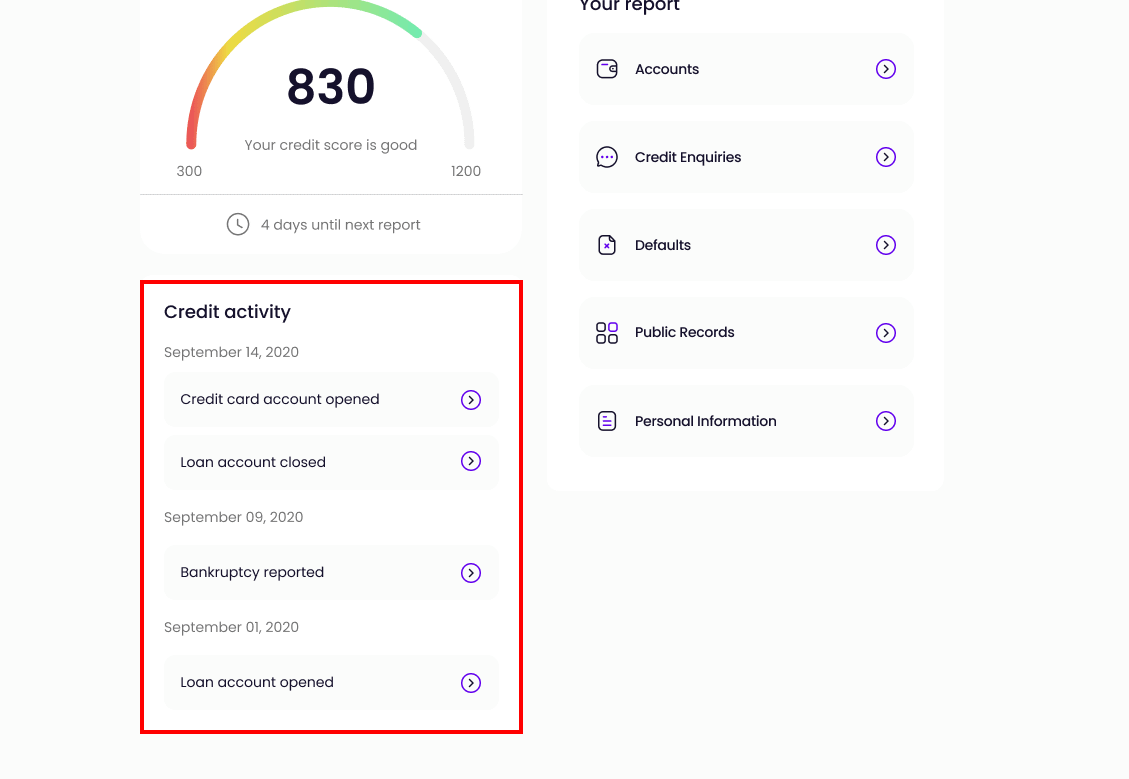
Below, we have highlighted where you can find your credit activity on Tippla. 

Credit Activity

3. New credit enquiries

If you have made any new credit enquiries – ie. applied for a loan or credit card, as an example, then these will also appear on your credit report. Credit enquiries will appear on your report regardless of whether you were approved for the loan.

4. Negative entries

Negative entries are events on your credit report which will lower your credit score. “Negative entry” refers to any negative financial behaviour that indicates that you haven’t effectively managed your debt.

Examples of negative entries include:

  • Late payments on loans or credit cards;
  • Delinquent accounts;
  • Charge offs;
  • Bankruptcies;
  • Accounts that have been sent to collection;
  • Foreclosures.

When your credit report updates, if any of the above is applicable to you, say you were late with a loan repayment or you have entered into bankruptcy, then this will appear in your updated credit report.

4. Personal information

When your credit report is updated, your personal information can also be changed. If you have moved to a new place, recently changed your name, or changed your employment, and you’ve let a lender or credit provider know, then your personal information could change.

It’s important to keep your personal information up to date and ensure it’s accurate. Having inaccurate personal information on your credit report can lead to multiple credit files in your name.

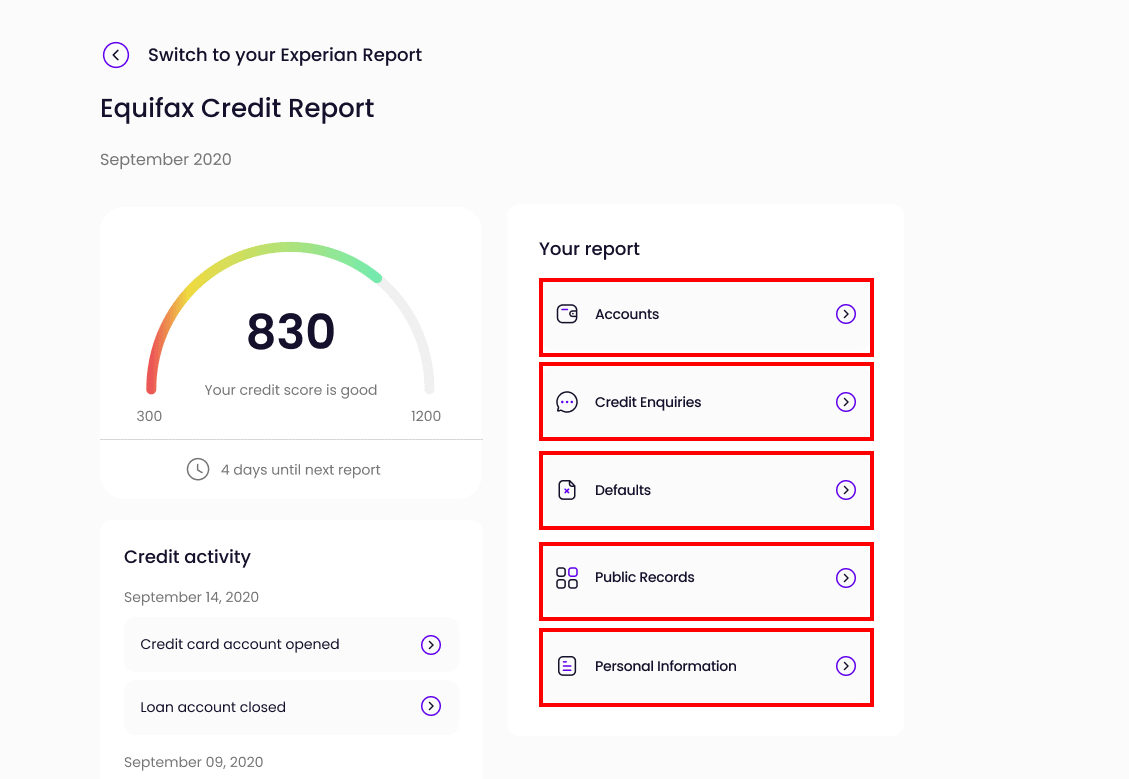
On Tippla, you can check for new credit accounts, enquiries, public records, court judgements and your personal information here:

credit enquiries

Why Is Your Credit Score Important? A Quick Overview

Why Is Your Credit Score Important

Whilst your credit score is only a number, it actually can impact your life in a very real way. So why is your credit score important? Tippla has the answers for you below.

What is a credit score?

Before we answer the question “why is your credit score important” it’s important to cover the basics first. What is a credit score? If you’re not sure what a credit score is – you’re not alone. In Australia, 73% of Australians don’t know their credit scores or why they are important.

Your credit score is a number ranging from 0 – 1,200. This number represents your creditworthiness (translation: how reliable of a borrower you are). The higher your credit score, the more reliable of a borrower you are perceived to be.

What is a reliable borrower?

A reliable borrower is someone who makes repayments on time. If a person takes out a loan, a reliable borrower would be expected to make their monthly repayments on time and during the length of the loan, completely repay their debt plus interest. 

For a lender, a reliable borrower is seen as less of a risk, as they are more likely to repay the loan in full. A risky borrower, however, might miss payments, or default on their repayments. This means the lender could lose money if the borrower can’t repay the loan. A risky borrower would likely have a below-average credit score.

Who can see my credit score?

Your credit score is sensitive information. This means, not just anyone can see your credit score. You need to provide consent in order for a company to see your credit score.

So when does this happen? Every time you apply for credit – this could be a loan, credit card, phone plan or utilities, you are giving the company you are applying to permission to view your credit score and credit report.

When the credit provider looks at your credit score and report, they can judge how risky of a borrower you are, and determine what products they would be willing to offer you. If you have a below-average credit score, your application could be rejected.

How many credit scores do I have?

In Australia, there are three credit reporting agencies (CRAs) – Equifax, Experian and illion. Equifax and Experian are the two largest global CRAs. Each month credit providers report consumer credit information to either of these three agencies. The information these agencies receive from credit providers is what they use to calculate your scores.

Because of this, you have not one, but three credit scores in Australia. You have one each from Equifax, Experian and illion, and an adjoining credit report which holds all the information your credit score is based on.

What’s the difference between your credit score and credit report?

Your credit report holds all of your recent credit history. This includes any current credit accounts – loans, credit cards, utilities, phone plan, etc. It will also have your repayment history for the last two years, any closed credit accounts from the past two years, and any negative entries (defaults, bankruptcy, court judgements, etc).

Your credit score is a number ranging from 0 – 1,200. Your credit score is based on the information held on your credit report. If your credit report shows a good credit history, then you will likely have a high credit score. However, if there are multiple negative entries on your credit report, then your credit score will likely be lower.

How are credit scores calculated?

This question is a bit tricky because the exact algorithm credit agencies use to calculate your credit score is a well-kept secret. Not only that, but each of the three agencies calculates your score slightly differently. This means your credit scores can be different across the three agencies.

Nonetheless, we do know the general factors they consider when calculating your credit score.

These are the general factors used to calculate your Equifax credit score:

  • The number of accounts you have;
  • The types of accounts;
  • The length of your credit history;
  • Your payment history.

For Experian, the main factors it considers when calculating your credit score are:

  • Type of credit providers that have made enquiries on your report;
  • The type of credit you have applied for;
  • Your repayment history;
  • The credit limit of each other credit products;
  • Negative entries;
  • The number of credit enquiries (credit applications) you have made.

When is a credit score used?

Credit providers, such as banks, lenders and other financial institutions, use your credit score to evaluate whether they should give you credit or lend you money. They use your credit score to determine how much of a risk you pose and decide whether you qualify for a loan or credit, how much interest they should charge you, and how high your borrowing limit should be based on your credit history.

Why is your credit score important?

With all of this in mind – why is your credit score important? There are several reasons why which we’ve outlined below.

Your credit score can help or hinder your application

Your credit score can be the difference between you being accepted or rejected for credit. If you are applying for a large loan and you have a below-average credit score, the lender you’re applying with might determine that you’re too risky of a borrower and reject your application.

A good credit score, on the other hand, could boost your application. If you have a strong credit history, then a lender might look at your application more favourably and approve your loan application.

This is one of the reasons why your credit score is important.

Interest rates

The interest rates you’re charged when you take out credit can end up costing you a lot over the lifetime of the credit. That’s why it’s a good idea to try and find loans, credit cards and other credit products with lower interest rates.

However, whether you can access low-interest-rate products can be heavily dependent on your credit score. Why is this? Lenders and financial institutions use interest rates as a way of protecting themselves against risk.

If you are deemed to be a risky borrower, then you will likely only be offered products with high interest rates. That way, they get more money out of you quicker, so if you default on a repayment, they could already have a decent portion of the money they lent to you repaid.

This is another reason why your credit score is important – it can determine what products you’re offered and, if you have a good credit score, save you a lot of money in the long term.

Borrowing limit

Your credit score can also affect how much you can borrow. As with most things, it all boils down to risk. The bigger the loan, the bigger the risk could be for the lender should you default.

If you have a below-average credit score, then a lender might decide that it’s not willing to offer you a high borrowing limit and reject your application or only offer you products with lower borrowing limits. 

However, if you had a good or higher credit score, then a lender could be willing to lend you larger amounts because you’re seen as less of a risk. This is how your credit score can influence how much you’re able to borrow.

What other factors do lenders look at?

It’s important to point out that your credit score is not the only factor that banks and lenders use to determine whether to lend you money. There are a range of factors they consider when making this decision. Nonetheless, your credit score is an important component of their decision.

Here’s what else they will likely consider:

  1. Your bank statements – credit providers will typically ask for your bank statements from the past three months. This way they can get an insight into your spending habits and savings so they can see if you are responsible with your money.
  2. Employment status and income – companies will want to ensure that you have reliable employment. Why? Because reliable employment infers that you are and will continue to receive regular income.
  3. Government benefits – if you rely too much on government benefits then companies might not be willing to lend you money.
  4. Gambling – do you gamble a lot? If so, this could be a red flag for lenders.

What is a good credit score?

A good credit score varies among the three CRAs. This is because they have different scales to rank your scores. Equifax measures your credit score on a scale from 0 – 1,200, Equifax, on the other hand, uses a scale of 0 – 1,000.

Here’s how they categorise your credit score:

what is a good credit score, good credit score

Source: Experian and Equifax

How can you improve your credit score?

There are many ways you can improve your credit score. Here’s a quick breakdown to get you started:

1. Space out your credit applications

Each time you apply for credit, the company you have applied with will check your credit score. This is known as a hard enquiry and it lowers your credit score. Therefore, it’s a good idea to space out your credit applications.

Instead of applying for multiple loans and types of credit at once, you could instead do your research and make sure you meet the criteria before applying. You could also just make one application and wait and see if you are approved before going on to apply for other credit.

2. Make your repayments on time

Your repayment history contributes to a good chunk of your credit score. If you can show that you can make your repayments on time whenever you take on credit, then this will reflect positively on your credit report and boost your credit score.

On the flip side, if you miss your credit repayments frequently, then these will be listed as defaults on your credit report. Each time you default it will drag down your credit score. Not only that, but defaults stay on your credit report for up to five years. 

This means each time you apply for credit in the next five years, every company you apply with will be able to see that you have previously defaulted on a payment. This will put you in the higher-risk category.

3. Check your credit report frequently

1 in 5 credit reports have some kind of mistake on them. This mistake could be an administration error, or it could be an indication that you’ve been a victim of identity theft.

Either way, mistakes in your credit report can harm your credit rating. That’s why it’s important to check your credit report frequently. That way you can identify a mistake early on and take the steps to remove the mistake.

4. Be consistent

Negative entries remain on your credit report for years. That’s why it’s important to be consistent with your good credit behaviour. One mistake can stay on your report for five years or more, and that mistake can affect your credit applications during this time. That’s why consistent positive credit behaviour can improve your credit score

The verdict: Why is your credit score important?

To sum everything up, here’s why your credit score is important: 

  • It could be the difference between you being accepted and rejected for credit;
  • It can determine your borrowing capacity;
  • It can affect the interest rates you’re charged (and either save or cost you money in the long term);
  • It can impact what utilities and phone plans you can access.

Want to learn more about your credit score? Tippla’s credit school may be of great help! Simply sign up with us today to access our free resources that can give you further guidance about your credit score and ways you can build and improve it.